Jan 6, 2021

GBM Brain Cancer

Ken, Nancy, Tim, Sarah

On November 25, 2020 my beautiful wife was diagnosed with a terminal grade 4 glioblastoma multiforme (GBM) brain tumor. Nancy had brain surgery on November 30 which allowed us almost seven more months together. We traveled out west a bit and prepared for what was to come. God blessed us with a time of new closeness and personal growth together unlike any we experienced in the previous 42 years. Two of our sons, Tim and Matt, were with me at her bedside when she passed away June 19, 2021 at 00:30. We all miss her dearly.

You can read about our journey at savorthebittersweet.blogspot.com.

Obituary


Nancy Lou Severn, 58 of Oostburg, passed away early Saturday morning, June 19, 2021 at her home, surrounded by her family.

Nancy was born to Glenn and Jean (Schnell) Steinbrecher on January 26, 1963. She graduated from Oshkosh West High School in 1981

Nancy was united in marriage to Kenneth Severn on June 4, 1983 in Oshkosh.

She was employed as a special education teachers’ aide at Plymouth and Cedar Grove-Belgium School districts.

Nancy enjoyed the Lake Michigan beach, paddle boarding, hiking, biking, but most importantly, investing in people and relationships, and living out her faith in Christ Jesus.

Nancy is survived by her husband of 38 years, Kenneth; children, Andrew, Timothy and Matthew (Malorie) Severn, and Sarah (Ross) Fale; grandchildren Desmond, August and Isla; parents, Glenn and Jean Steinbrecher; siblings, Deb, Susan, Brian, and Lauri; parents-in-law Doris and Robert Lowell; sister-in-law, Ruth; nieces, nephews, other relatives, and friends.

She was preceded in death by her sister Judy in November, 2020; her sister in-law Susan, March 2020;  and father in-law William Severn.

Private family services will take place at a later date.

Nov 17, 2020

Raspberry Pi 64 bit OS Boot from USB

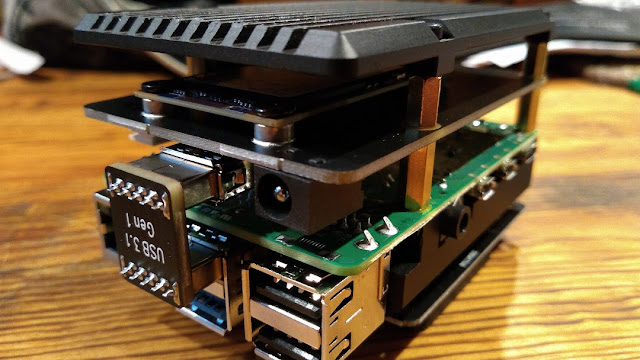
The X857 mSATA shield makes a nice, clean package for a USB boot Raspberry Pi 4 with SSD

For some time now, I have been trying to get the Raspberry Pi 4 to boot from USB. A couple reason to make this change are, the integrity of SSD over the SD card is substantial, and of course the benefit of greater data transfer speeds. 

As more Pi fans jump on this wagon, hardware is becoming available for this specific upgrade. One example of this is the Gookworm X857 mSATA shield for the Raspberry Pi 4. This fits directly under the Pi 4 and connects with one of the USB-3 ports. Under the shield, I mounted a 120 GB mSATA SSD. 

To boot from USB on a Raspberry Pi 4 (4GB or 8GB), install the new Raspberry Pi 64 bit OS and the USB boot configuration will be exceptionally easy. Here are the simple steps to follow.

  1. Download, install, and update the Raspberry Pi 64 bit OS to a SD card
  2. Copy the SD card to a SSD and connect the SSD to the Raspberry Pi 4 USB-3
  3. Open Raspberry Pi Imager, write Raspberry Pi 4 EEPROM boot recovery to a clean SD card
  4. Shut down, remove the OS SD card, insert the EEPROM boot recovery SD card
  5. With the SSD connected to a USB 3, and the EEPROM SD card in, power up the Raspberry Pi
  6. A constant, fast flashing green LED and green screens means it worked
  7. Shut down, remove the SD card, and restart
  8. Grin at your new USB boot Raspberry Pi 64 bit system
The mSATA drive installed with the armor case bottom (upside down)

Nov 13, 2020

Fusion

 My first experience with System Fusion came not long after I purchased a Yaesu FT-991A. My intention was only to upgrade my HF rig, but then I thought the addition of the 144/440 SSB, FM, and C4FM in a single transceiver may open some new avenues to explore.

For a while, the opportunity to use System Fusion never came about. Area hams expressed loyal dedication to D-Star even though no D-Star repeaters existed in our area. Investing in the newer System Fusion C4FM digital mode was, let's say, less than palatable for them. This really put YSF on the outside looking in.

Since I couldn't use YSF locally, I decided to program the 991A with all repeaters in a 50 mile radius of home and then find which of those might be YSF. I found a few, but one of them was well within reach, the W9RH repeater in Milwaukee, running YSF in Automatic Mode Select (AMS) and with WIRES-X connectivity. A few minutes later, with amazing clarity and no analog static, I began listening to a QSO between Milwaukee, Illinois, and Minnesota hams on YSF over the WIRES-X linking system. A short time later, I was on the air with YSF and loving it.

As digital radio and codec technology continues to advance, such as with WIRES-X, MMDVM hotspots and repeaters, and the new AMBE servers, access to world-wide digital mode communication is almost taken for granted. These advances in digital voice technology have helped bring new amateur radio enthusiasts into the fold more than ever before.

Many hams that are new to the digital modes have expressed some confusion with the differences between YSF, System Fusion, C4FM, and WIRES-X. Hopefully this helps.

Yaesu System Fusion (YSF) is a mode - A proprietary mode of modulation based on Continuous Four-Level Frequency Modulation (C4FM), which is a type of Four Frequency Shift Keying (4FSK), based on Frequency Division Multiple Access (FDMA). More can be found here on Yaesu's System Fusion page.

WIRES-X is a network - A closed proprietary network of interlinked HRI-200 digital nodes, Yaesu C4FM digital repeaters, and Yaesu C4FM digital radios, all carried over Yaesu servers hosting network "rooms" or talk groups. More can be found on Yaesu's WIRES-X page.

While being a closed proprietary network, WIRES-X can be bridged to other networks like the YSF network and FCS network, but other networks cannot bridge into the WIRES-X network.

So how do you program "codeplugs" for your YSF radio? You don't. It's just a mode, not a mode and network. No color codes, or groups, or channels, or time slots to program. Simply push a button to turn it on or turn it off.

YSF Tips

FT-70D

Stop the squeal/squelch after receive from hotspot. Long-press the AMS button to turn off AMS.

updated: 11/13/2020