Mar 22, 2022
Desert Experience
Jul 7, 2020
Updated Shack - Episode II
May 10, 2020
Updated Shack - Episode I

The planet earth has seasons, and that's a good thing because who can take twelve months of winter? I go through seasons too, probably just like you. Sometimes I get kind of bored with things and just need a change. Other times, after using something for a while, I get to a certain level of frustration that I ask myself, "Why do I put up with this?". Then the creative juices begin to flow and my tiny Shack gets an update!
I decided to take my credenza and add a small shelf to the front to hold a keyboard or two. Then I added a small back-angled shelf on top to hold the radios and allow small storage under the radios. Lastly, I added a back panel to mount two monitors, an antenna selector switch (behind the right monitor), and a RigRunner 4007U (below the monitors). The HP VH240a HDMI monitors with built-in speakers are mounted with Mount-It! MI-2829 tilt-swivel brackets. Two large pass-through holes at the base of the back panel put all wiring behind the credenza for a nice, clean install. A small shelf up top is home for the HTs, the ZUMspot and some other small things.
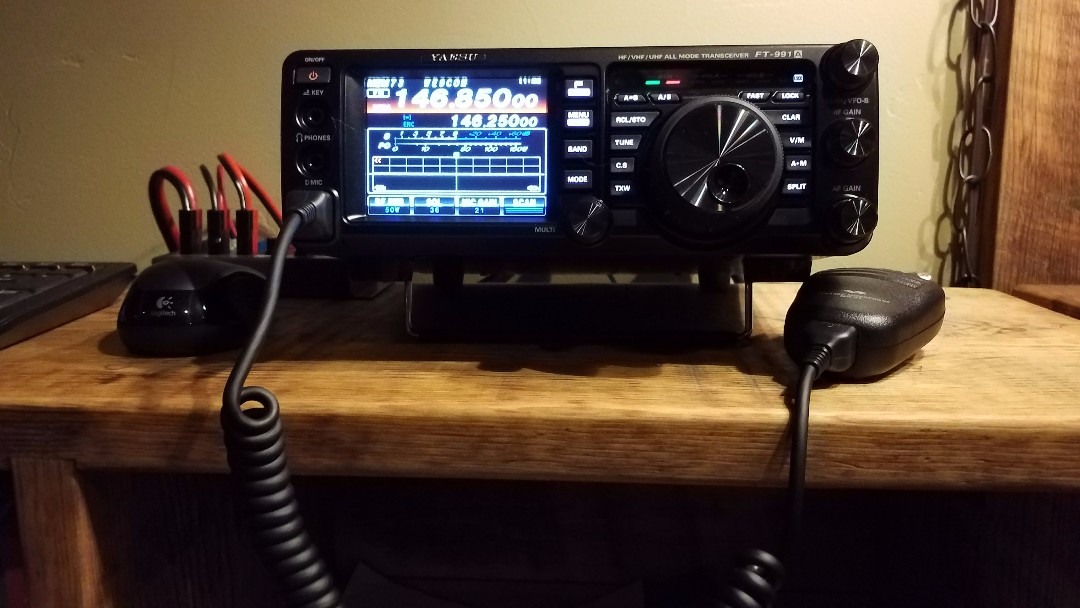
The shack is now run entirely on a Raspberry Pi 4B 4GB with the latest Raspberry Pi OS. The Debian Ham radio bundle which includes CQRLOG, JS8Call, WSJT-X, FreeDV, and a few other helpful programs, drive my USB connected Yaesu FT-991A. A Rowetel SM1000 sits to the right of the FT-991A. Also pictured is a Yaesu FTM-7250DR, and my old FT-7800R which will be trading places with my less-old FT-7900R, now used for local repeaters and simplex in my workshop.
Right now, I am quite content with this setup. But yes, I still have to get the old Barker & Williamson BWD-90 folded dipole up for HF. I like the GAP Titan DX, but verticals are so noisy compared to the folded dipole. And then I should probably do this, and maybe do that, or maybe just... be content!
So now I can enjoy Ham radio again at my tiny new shack. And then the next season will come. Change can be good, and God is always good!
Aug 21, 2019
CQRlog
![]() |
| CQRlog 2.5.2 on Linux Mint 21.3 |
Long ago, while looking to get off the Windows bandwagon, I experimented with Linux, Redhat, and a few other OS's, but recently, I was introduced to Raspbian, a Debian-based / Linux-based OS designed for the Raspberry Pi computer. My opinion of Raspbian so far is very positive. The fact that the OS is free, and thousands of programs are available for free, helps my wallet recover from the ever-expanding money pit Windows based computers can be.
I am a big fan of Ham Radio Deluxe, a fantastic Windows-based program, but now it is quite expensive, initially $100, then $50 per year for maintenance. And if you still mail out QSL cards, the annual cost of the hobby can really eat into the household budget. More recently, I was using the Log4OM software, another fantastic Windows-based program that has most of the bells and whistles of HRD, but the best part is Log4OM is free, but please make a donation to their work if you like it.
Update
September 29, 2020
So it's been over a year now since I started using CQRlog, and well, I'm still using it and I really like it! Logs are super easy to set up, updates to several online logs can be automatic and in real time, and the integration with LoTW is great.
Services from the website HamQTH - from the makers of CQRlog and RemoteQTH - are well integrated into the CQRlog software. No nagging ads and no subscription fees. If you like the software and services, you are free to make a much appreciated donation.
This software has been very stable, reliable, and easy to use. I did have it crash twice, but I believe it was related to a rig control conflict I created by using several programs wanting rig control at the same time. My bad. As you can see, the appearance of the many interfaces are nice, clean, and up-to-date, unlike so many ham programs with the vintage 1980's, DOS-to-Windows transition look.
CQRlog is clearly at the top of my list for logging software. See the CQRlog website for more.
Jun 26, 2019
DX vs. MMDVM
For a while now, its been a little tough to get regular DX the old-fashioned way. Aside from that, FT8 works fairly well on 20m, but that's not for everyone, and it pretty robotic and impersonal. There isn't enough people on HF DV like the FreeDV 1600 and 700D modes, so it's less than a thrill right now.
That being said, there is hope. There has been a tremendous increase of activity on the MMDVM front. With new gadgets hitting the market as fast as baby rabbits, even the Tech hams can now talk around the world, and on an HT to boot! Yeah, it's not like the traditional and personally rewarding "contacts" like we are used to, flexing our RF muscles in cunning and calculated ways, but the end result is the same. Hams talking to hams around the world, and how cool is that!
So my FT-991A isn't used quite as much right now for DX, but the FTM-400XDR and FT-70D are barking up a storm from my ZUMspot and a few connected Yaesu WIRES-X repeaters in the area. My favorites right now are America Link and MNWis. Ride the wave, baby! But if the internet goes down, make sure you are squared away in your own shack. Independence is highly rewarding!
Aug 6, 2018
Yaesu FT-991A with GPS

Now when you key up on a C4FM repeater - as well as with a few other functions - your location/distance is also transmitted/received for the other stations. And if it makes your day, you get the cool little green GPS satellite icon showing up on the FT-991A touchscreen. Nice!
Update: Oct 2020

Dec 12, 2017
Into the Future
So far, I can say I am impressed with the YSF digital signal. I was listening to the Milwaukee W9RH YSF repeater last night and it was exceptionally clear and strong, and that repeater is just 20 watts. I can hardly wait to get on the air and try it out for myself. It would be nice to see more YSF repeaters out there with their dual analog/digital capability modes.